At the Heart of the Tour de France: Lessons from a Unique Brand Activation Platform
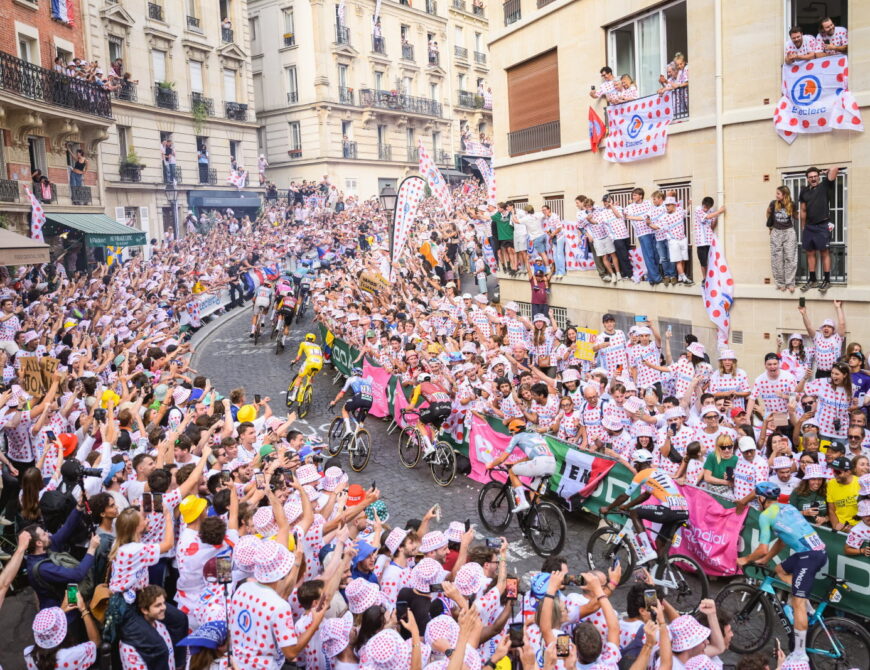
Photo: A.S.O./Charly Lopez
Why one of the world’s biggest sporting events offers brands an exceptional activation platform — provided they understand its codes, respect its heritage and bring genuine value to the experience.
The Tour de France is the world’s third-largest sporting event, behind the Olympic Games and the FIFA World Cup. Yet it has one major point of difference. Unlike these two global events, it takes place every year, and most of the experience along the roadside remains free and open to everyone.
Its scale gives a sense of the phenomenon. In 2026, the Tour is broadcast in 190 countries by 100 channels, 60 of them live, while the international feed generated more than one billion viewing hours in 2025. In France, the 2026 edition reached 45.6 million people across France TV’ channels and platforms, representing 72% of the population aged four and over.
Yet reducing the Tour to the size of its audience would mean missing what truly makes it unique for brands.
Its strength lies not only in how many people it reaches, but in the way it reaches them.
The Tour is a lived experience. A popular celebration deeply rooted in French culture and heritage. A summer tradition shared across generations, bringing together sport, landscapes, cities and villages, hours spent waiting by the roadside, encounters and shared emotions. The public does not simply watch. It becomes part of the show.
L’Uzyne, the French member of the EAA network, currently supports several Tour partners, including Tourtel Twist, Panzani, McCain and Biogents. And after more than twenty years of experience on the Tour de France, one conviction stands out. This event offers a Brand Activation platform unlike any other.
- Have a Good Reason to Be There
Brands have been part of the Tour’s history for almost a century. Since 1930, the advertising caravan has travelled ahead of the peloton and gradually become an integral part of the event itself. Even today, one spectator in two says the caravan is their main reason for coming to the Tour.
This is an unusual situation. At many events, commercial messaging can feel intrusive. On the Tour, the public is also waiting for the brands.
But this historical legitimacy is not enough. Today, almost fifty commercial partners compete for attention around the Tour. In such an environment, rights guarantee presence, not relevance.
Rights provide access to an exceptional platform. Activation turns that presence into brand value.
So everything starts with a simple question. Which part of our brand identity can naturally connect with what the audience has come to experience?
McCain’s return in 2026 is a good example. With brand awareness already extremely high, the objective is not to become better known, but to build consideration and preference while reinforcing a brand territory centred on sharing.
Fries are naturally associated with conviviality and sharing. The Tour itself is a huge collective experience. The fit between the brand and the event therefore feels natural.
The new partners joining in 2026 are taking different approaches. Danette builds on the connection between two popular French icons. Charal brings its world of food and barbecues directly into the celebration, while Groupama has developed prevention and awareness initiatives that give tangible expression to its promise of proximity.
The same thinking now applies to the Tour de France Femmes avec Zwift, which in just five editions has become a sporting and marketing property in its own right. Some brands choose to build their partnership across both Tours. Others make a more focused choice.
Teisseire, a former partner of the men’s Tour, decided to return exclusively through the Tour de France Femmes avec Zwift, where it sponsors the Combativity Award, and has recently extended its partnership until 2029. This decision is based precisely on the alignment between the values the brand wants to champion and those it associates with the event. Zwift, the title partner since the race was created, made the same bet from the outset by supporting the development of women’s cycling.
The biggest platform is not necessarily the most relevant one.
Authenticity does not mean being discreet. It means having a good reason to be there.
- Be Distinctive in Just a Few Seconds
This is probably the rule that experience on the ground has taught us most often.
Spectators spend an average of 7 hours and 22 minutes by the roadside enjoying the caravan and the race. The caravan itself provides around 40 minutes of entertainment. But when your brand passes in front of them, it may have only a few seconds to create a lasting memory.
In that context, an idea that is too complex is unlikely to work. A brand needs to be instantly recognisable through a shape, a colour, a sound, a character, a gesture or an experience that can be understood almost immediately.
Panzani provides a good example. Its activation combines five highly designed vehicles, XXL visuals, the brand’s jingle, a Farfalle mascot and even the scent of basil diffused along the route. A total of 300,000 packs of pasta and 90,000 bandanas were also distributed throughout the Tour.
The value does not lie in volume alone. The experience designed by L’Uzyne engages several senses so that just a few seconds of contact immediately evoke the brand’s world.
On the Tour, distinctiveness often matters more than sophistication.
And this lesson goes far beyond the caravan. The denser, more mobile and more spectacular the environment, the more important it becomes for a brand to simplify its expression without diluting its identity.
- Add to the Experience Rather Than Interrupt It
A brand can be visible without being appreciated. The real question is what it brings to the moment people are experiencing.
That contribution can take many forms: entertainment, refreshment, product sampling, a useful service, a surprise or simply a souvenir that people will enjoy keeping.
The Tour’s arrival in Paris in 2026 provided a spectacular illustration. On the streets of Montmartre, thousands of spectators wore the red polka dots associated with the best climber’s jersey sponsored by E.Leclerc. T-shirts, caps, berets and flags gradually transformed the crowd itself into a “sea of polka dots”.
What matters here is not simply the brand’s visibility. It is the way people make those codes their own. Spectators wear them because, at that particular moment, they have also become part of the celebration.
The consumer is no longer simply an audience to reach. They become a participant in the activation.
This relationship also helps explain why traditional promotional giveaways still play such a distinctive role on the Tour. According to Kantar, 90% of spectators want to receive souvenirs from the caravan and, more importantly, 78% say they keep the items they receive and consider them useful.
Interaction can also have measurable effects on the brand. For Tourtel Twist, a Kantar study gave the caravan and its activations an 8.3/10 rating, ranking it second among twenty caravans tested. 66% of respondents said they intended to buy a Tourtel Twist drink within the following twelve months, while brand image scores were higher among spectators who had interacted with the activation.
Of course, this does not mean mechanically attributing a purchase to a few seconds of activation. But these results underline an essential point. The quality of a contact matters as much as the quantity.
- Extend the Experience Beyond the Roadside
The physical experience remains at the heart of the Tour’s power. But today it forms part of a much broader ecosystem spanning television, social media, digital channels, retail, packaging, Fan Parks, PR and hospitality.
The objective is not to add a digital layer artificially around an activation. It is to extend an emotion that originated on the ground.
Procter & Gamble provides a good illustration in 2026. Several of the group’s brands are activated around both the Tour de France and the Tour de France Femmes avec Zwift, with different expressions reflecting their individual brand territories, while the partnership also extends into more than 1,000 retail outlets and e-commerce platforms.
McCain has chosen a different build-up. Ahead of its announced return to the caravan in 2027, the brand is already activating around the Tour in-store, on packaging, through media and within the Fan Parks.
In both cases, the live experience creates the moment, while the other touchpoints give it a longer life.
The Tour’s digital reach naturally helps amplify that experience. But it does not replace what makes the event so distinctive. Emotion is first created through direct contact and a shared collective experience.
For a brand, real performance therefore lies in connecting the different touchpoints without diluting that initial emotion.
- Think Globally, Execute Locally — and Responsibly
The Tour has global reach, but its execution is deeply local.
Every morning brings a different environment. City centres, villages, rural roads, mountains, weather conditions, topography, crowd density, regulations and logistical constraints all require constant adaptation.
And behind the apparent simplicity of the celebration is a genuine travelling city. Around 4,500 to 5,000 people and more than 3,000 vehicles move with the event from stage to stage.
For an international brand, the lesson is particularly clear.
Consistency does not mean uniformity.
A concept needs to be strong enough to remain instantly recognisable from one territory to another, but flexible enough to work within very different local realities.
This is also the principle behind EAA’s model: a shared ambition and overall consistency, combined with local expertise capable of turning an idea into a genuinely relevant experience on the ground.
That requirement now also extends to environmental responsibility.
An event of this scale inevitably generates impacts. The point is not to pretend they can simply disappear, but to measure them, reduce them and factor those constraints into the design of activations from the outset.
The Tour is progressively changing its vehicle fleets. In 2026, 100% of the vehicles dedicated to the organisation are hybrid or electric, while a growing number of partner vehicles use alternative powertrains.
Agencies also have a role to play. For the past three years, L’Uzyne has successfully been testing the use of biofuel in some of the vehicles used for the advertising caravans it operates, exploring solutions adapted to the very specific constraints of this kind of roadshow.
The same thinking needs to apply to promotional items, materials and the territories through which the event travels. The heatwaves and wildfires that led to changes to certain stages in 2026 are also a reminder that the Tour must now both reduce its own impact and adapt to the consequences of climate change.
Activation performance and responsibility can no longer be considered separately.
A Lesson That Goes Beyond the Tour
The Tour de France combines qualities that are rarely found together on this scale: a global audience, a deeply rooted heritage, a free and popular experience, direct physical contact with the public and an exceptional ability to extend that emotion across multiple touchpoints.
That is precisely what makes it a unique laboratory for Brand Activation.
For international brands, this singularity is a reminder that a global idea only reaches its full potential when it can adapt to the local context.
Ultimately, the lesson is simple. The strongest activations do not try to interrupt an experience people already love. They find a relevant way to become part of it.